Apologies for this taking too long to write out...Anyway, where was I? Ah yes, solar events and space weather! (Heavens above, so many sentences starting with an A! Alpha alliteration!) I'm not going to bother with the aurora borealis/australis, because it's so well-known that I figure it's not worth talking more about. Here goes:
Solar wind: This is made up of all the charged particles and plasma that escapes the Sun's enormous gravity and shoots off at near-light speed in all directions. If it sounds dangerous, it is. This is one of the many things that astronauts have to protect themselves against when they go into space. It's a boatload of radiation; you think a sunburn is bad? The Earth's atmosphere blocks or absorbs 45% of the energy that hurdles towards us from our star (cute infographic from NASA here). At least it used to, but that gets into a lot of complicated conversations about ozone and other things for which I don't have the chemical background. Suffice it to say, we'd fry if we were outside (or without) the atmosphere.
It's not just scattering from ozone or air and water particles, the magnetosphere helps buffer us as well; think of rain on a windshield. The rain may be blowing directly at the driver, but it hits the windshield and is deflected upwards, never reaching the occupants. The same thing happens with the Earth and the magnetosphere: solar wind streams at us, but since it is composed largely of ions (charged particles), they are deflected by the magnetic envelope around our planet, channelling north or south to the poles, where the magnetic lines reach down into the Earth.
Sunspots: these are irregular dark areas on the Sun that, honestly, we can't quite understand. They're caused by fluctuations in the magnetic fields under the surface (remember the lines in the hot gas are like seething spaghetti, it isn't neatly ordered), and they're cooler than the rest of the Sun's surface. That's why they're darker. We know that they tend to be more common during the peak of the 11-year solar cycle, and they show up less often during solar minimum (the technical term for sunspot off-season). We also suspect that longer-term quiet periods of sunspot activity have led to massive cold snaps on the Earth...massive as in the last time there was a significant dearth of sun spots -- known as the Maunder Minimum -- we went through the little ice age of the 17th century.
So if we know all that, what do we not understand about sunspots? Well, we don't know really why they form (the solar cycle is a mystery, all we know is the "spaghetti" closest to the surface shows up as sunspots), and recently we haven't been terribly good at predicting them. The solar minimum and maximum from the last solar cycle was not easily differentiable, and we are having more sunspots during the current solar minimum than we "should" be having. Furthermore, we haven't had modern scientific methods and records for long enough to show a real correlation between sunspot activity and ice ages, which is a pretty important thing to know. Even if we did have the data to show a correlation, we have no clue as to why the absence of dark patches on the Sun should make the Earth colder.
Prominences/Coronal Mass Ejections (CME's): The Sun isn't always just a big glowy ball of sunshine. It has bright, glowing loops of plasma that crackle and swirl between sunspots, like wiggly horseshoe magnets. These flow between oppositely-charged sunspots, much like electric current flows along a wire connecting the terminals of a battery. They vary in size (multiple Earth's can fit inside them, sometimes they stretch across half the Sun's diameter), and sometimes they can snap, lashing huge gouts of ionized plasma out at an unsuspecting patch of sky -- that we are sometimes occupying. These solar whip-cracks are known as coronal mass ejections, or CME's.
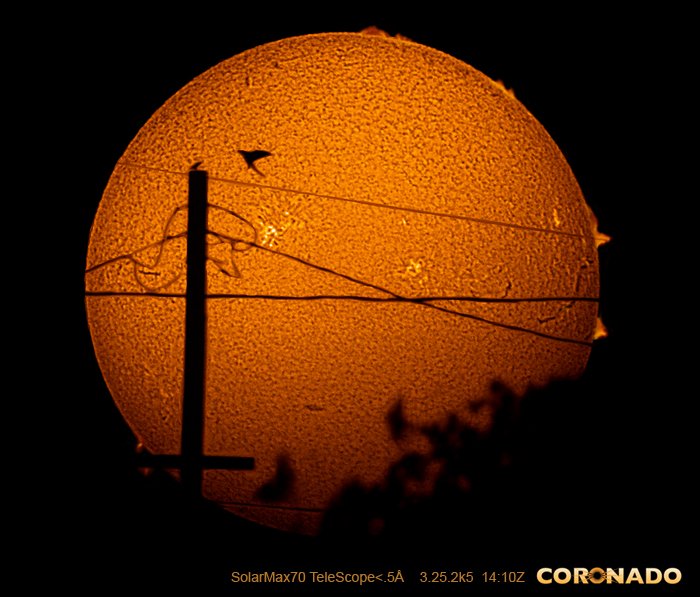
One of the awesome things about prominences are that they are large and therefore fairly easy to see through a solar telescope (NOTE: this is not a regular telescope, do not look at the sun through a normal telescope unless someone you trust with your ocular health has attached the proper accoutrements to do so, or your eyes will fry). Even if they aren't on the rim of the Sun from our vantage point, with a hydrogen-alpha filter you can still see them as snaky lines across the surface. Take a look at this amazing picture (click here), and think about the fact that each of those features is likely multiple Earths wide. It's beautiful, and terrifyingly violent, and intensely close.
Solar Flares: These are large bright spots in the solar atmosphere, when lots of electromagnetic energy is released and dissipated across the Sun. They occur near sunspots, which are highly active electromagnetic regions as we discussed earlier, so you could think of sunspots as being like storms, and flares being like lightning. However, a single solar flare can give off the equivalent energy release of millions of atomic bombs, so the scale is quite a bit larger than it is on Earth. NASA has a pretty good, not overly-technical article on them here (click here).
Hope you enjoyed the perusal of solar events! If you want to keep up on what's happening out in our neck of woods, I cannot recommend www.spaceweather.com highly enough. It's one of my favorite sites, and Dr. Phillips has forgotten scads more solar science than I will ever know. I'll return to this topic soon though, and then you'll get to hear my theories on our planet's future relationship with the Sun. Stay tuned!
Showing posts with label observational astronomy. Show all posts
Showing posts with label observational astronomy. Show all posts
Tuesday, January 8, 2013


Tuesday, November 20, 2012
Cosmic Face-off
It's almost December, 2012, and some people are panicking. Apparently one of the apocalyptic theories is centering around a planetary conjunction (link) happening in a few weeks. I'm going to ignore the apocalyptic part entirely (already read the news today, thanks) and focus on conjunctions, which have boggled me as astronomical "events" for years now.
In fact, there's a basic division I've noticed across amateur astronomers, that I've never really understood. Forget quibbling over 'scope type or comparing CCD camera specs, this is a base-level aesthetic difference. I'm talking about the conjunction/cluster faction vs. the objects faction.
To clarify, in the first group, I'm placing the group of astronomy buffs who go out in the middle of winter, stand on piles of newspaper with a thermos, 12 layers of clothes, and 2 sets of gloves on in order to watch a conjunction or track down an open cluster. In the second group, I'm placing the group of astronomy buffs who go out in the middle of winter, stand on piles of newspaper with a thermos, 12 layers of clothes, and 2 sets of gloves in order to take a several-minute exposure of a nebula or sketch a galaxy. It's not that people don't dabble in both, but most astronomers I've known have a preference for one or the other.
Bias alert: I'm in the second group. I just don't get the attraction of watching a planet and a star appearing to approach each other, or seeing a blob of stars that formed together hanging in space. Give me the faintly-glowing building blocks of the Universe, the bright, whirling arms of a star cradle, or the death-ring of a planetary nebula. Something to really wrap my mind around the varied nature of the dimensions in which we live.
Conjunctions just baffle me. We see shapes in the sky all the time: sometimes they're made of stars, sometimes they're made with planets, but they're just all bright dots from here. We've known for quite some time that they aren't actually close to each other, so what is the attraction? I can see sitting up all night looking at Jupiter or Saturn by itself, but they're only fascinating to me as visible objects, not "stars." Stars are fascinating to think about in comparison to our own Sun, to imagine the other lives that might be orbiting them, or as parts of a constellation telling an old (and probably creepy) myth, but not solely as bright dots in the night sky.
Somehow, I feel astronomy guilt over this, like there's something I'm missing about the philosophy of observational astronomy. I know, objectively, that a sparkling smudge of starlight from a galaxy millions of lightyears away is no more or less appealing than a conjunction, Nature's temporary installation in the cosmic art gallery. But, like most art, I just don't get it. If anyone from the other side of the fence would like to jump in and explain what I'm not seeing when I look up, feel free, I'd love to finally get it!
In fact, there's a basic division I've noticed across amateur astronomers, that I've never really understood. Forget quibbling over 'scope type or comparing CCD camera specs, this is a base-level aesthetic difference. I'm talking about the conjunction/cluster faction vs. the objects faction.
To clarify, in the first group, I'm placing the group of astronomy buffs who go out in the middle of winter, stand on piles of newspaper with a thermos, 12 layers of clothes, and 2 sets of gloves on in order to watch a conjunction or track down an open cluster. In the second group, I'm placing the group of astronomy buffs who go out in the middle of winter, stand on piles of newspaper with a thermos, 12 layers of clothes, and 2 sets of gloves in order to take a several-minute exposure of a nebula or sketch a galaxy. It's not that people don't dabble in both, but most astronomers I've known have a preference for one or the other.
Bias alert: I'm in the second group. I just don't get the attraction of watching a planet and a star appearing to approach each other, or seeing a blob of stars that formed together hanging in space. Give me the faintly-glowing building blocks of the Universe, the bright, whirling arms of a star cradle, or the death-ring of a planetary nebula. Something to really wrap my mind around the varied nature of the dimensions in which we live.
Conjunctions just baffle me. We see shapes in the sky all the time: sometimes they're made of stars, sometimes they're made with planets, but they're just all bright dots from here. We've known for quite some time that they aren't actually close to each other, so what is the attraction? I can see sitting up all night looking at Jupiter or Saturn by itself, but they're only fascinating to me as visible objects, not "stars." Stars are fascinating to think about in comparison to our own Sun, to imagine the other lives that might be orbiting them, or as parts of a constellation telling an old (and probably creepy) myth, but not solely as bright dots in the night sky.
Somehow, I feel astronomy guilt over this, like there's something I'm missing about the philosophy of observational astronomy. I know, objectively, that a sparkling smudge of starlight from a galaxy millions of lightyears away is no more or less appealing than a conjunction, Nature's temporary installation in the cosmic art gallery. But, like most art, I just don't get it. If anyone from the other side of the fence would like to jump in and explain what I'm not seeing when I look up, feel free, I'd love to finally get it!
Subscribe to:
Posts (Atom)